



If you’ve received approval for Spain’s Digital Nomad Visa in 2026, congratulations — but several time-sensitive administrative steps remain to secure your legal residency, tax status, and ability to work. Complete these tasks promptly to avoid fines, missed benefits, or delays. This guide covers what to do after approval, required documents, realistic timelines, common mistakes, and when to contact a trusted advisor for help with the post-approval stage.
Key post-approval steps (overview)
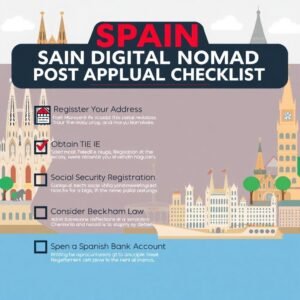
– Empadronamiento (register your address)
– Obtain the TIE (Tarjeta de Identidad de Extranjero)
– Register with Social Security (Autónomo vs. employment)
– Consider tax optimization (Beckham Law eligibility & deadlines)
– Open a Spanish bank account and get a local SIM
– Keep records and plan tax residency timing
1) Empadronamiento — register your address
What it is: Local town-hall registration that issues a residency certificate (padrón). This certificate is required for many other processes (TIE, Social Security, tax forms).
Documents typically required:
– Passport and visa approval
– Rental contract, property deed, or landlord authorization
– Completed padrón form (varies by municipality)
Timing: Do this immediately after you have stable accommodation. Some municipalities issue certificates that must be renewed or used within a limited period — submit supporting documents promptly.
Tip: Keep copies and get an official stamped certificate for later appointments.
2) Obtain your TIE (physical resident ID)
Why: The TIE is your official ID card in Spain and is required for everyday legal and financial activities.
Steps:
– Book a fingerprinting appointment at the local Foreigner’s Office or police station.
– Complete and submit the EX-17 form and pay the administrative fee (Tasa 790-012; typical fee ~€16).
– Bring passport, passport photo, Empadronamiento certificate, visa approval notice, and the stamped bank receipt.
Timing: Book as soon as your visa approval allows. Delays can complicate opening accounts or formal registration tasks.
Tip: Bring copies of all documents and confirm appointment instructions on the local police website.
3) Social Security registration (Autónomo vs. employed)
Who needs to register: All residents who will work in Spain. Structure affects contributions and benefits.
– Employed by a Spanish company: employer typically registers you.
– Self-employed (Autónomo) or freelance: you must register as Autónomo with Social Security and with the tax authorities (Agencia Tributaria).
Important: The registration date triggers social contributions and counts toward deadlines (e.g., tax regime applications).
Tip: Consider provisional contribution schemes (reduced startup rates) available to new Autónomos and confirm your monthly minimums.
4) Tax considerations — Beckham Law and residency rules
Beckham Law (special regime): May offer a favorable flat tax rate (historically around 24%) for qualifying inbound workers, but 2026 requirements are strict.
Key points:
– Filing forms (e.g., Form 030, Form 149) and online registration are time-sensitive — often within six months of registering for Social Security or arriving in Spain. Missing the window typically disqualifies you.
– Confirm eligibility: there are conditions on prior residency, type of employment/income, and duration.
General tax residency: Spending 183+ days in Spain usually makes you a tax resident; declare worldwide income if resident.
Tip: Start tax planning early — small timing errors can have major tax consequences.
5) Banking, utilities, and communications
Why: A Spanish bank account simplifies rent, payroll, Social Security payments, and tax filings.
Documents needed: Passport, TIE or proof of visa approval, Empadronamiento, and proof of income/employment.
Utilities and SIM: Set up utilities and a local SIM immediately — many government portals require SMS verification. Use SEPA direct debits for recurring payments.
Tip: Some banks offer non-resident accounts first, then switch after TIE issuance.
6) Record-keeping, health coverage, and insurance
– Keep digital and physical copies of all registration receipts, forms, and appointment confirmations.
– Health coverage: confirm whether you’re eligible for public healthcare via Social Security contributions, or maintain private health insurance until coverage begins.
– Consider income protection and liability insurance relevant to remote work.
7) Timeline & priority checklist (first 6 months)
– Days 0–14: Secure accommodation, Empadronamiento.
– Days 0–30: Book TIE appointment; open a local bank account (non-resident if needed).
– Within registration month: Register with Social Security (Autónomo or employer registration).
– Within 6 months: Apply for Beckham Law / special tax regimes (if eligible).
– Ongoing: File taxes on time, maintain records, renew TIE as required.
Common pitfalls
– Missing the Beckham Law six-month deadline.
– Not registering Empadronamiento before other appointments.
– Delays in TIE appointments leading to difficulties opening accounts or accessing services.
– Assuming visa approval equals immediate access to healthcare or tax benefits without registering with Social Security.
Documents checklist (keep ready)
– Passport + visa approval letter/certificates
– Empadronamiento certificate
– Rental contract or property deed / landlord letter
– Passport-size photos
– EX-17 form (TIE), Tasa 790-012 receipt
– Social Security registration forms / business documentation
– Tax forms for Beckham Law (where applicable)
When to contact a reliable advisor
If you want to avoid costly timing errors, ensure Beckham Law eligibility, set up the correct corporate or freelance structure, or need help with bureaucratic appointments, contact a trusted immigration and tax advisor for the post-approval stage. Professional advisors can:
– Confirm eligibility and file tax-regime applications within deadlines
– Help schedule and prepare TIE and Social Security appointments
– Set up optimal invoicing, VAT, and cross-border tax planning
Need help with post-approval formalities?
Contact CitizenXpert for a reliable advisor to manage your post-approval stage — from Empadronamiento and TIE booking to Social Security registration and Beckham Law applications. Our experts handle documentation, deadlines, and appointments so you can focus on settling into Spain. Request a consultation.
You can learn the Spain DNV application process and information through this link
Further reading and sources
– Official police/immigration and Social Security websites (check your local provincial office for appointment portals).
– Specialist tax and immigration blogs for practical step-by-step tips (keep legal advice local and up to date).