



If you’ve received approval for Spain’s Digital Nomad Visa in 2026, congratulations — but several time-sensitive administrative steps remain to secure your legal residency, tax status, and ability to work. Complete these tasks promptly to avoid fines, missed benefits, or delays. This guide covers what to do after approval, required documents, realistic timelines, common mistakes, and when to contact a trusted advisor for help with the post-approval stage.
Key post-approval steps (overview)
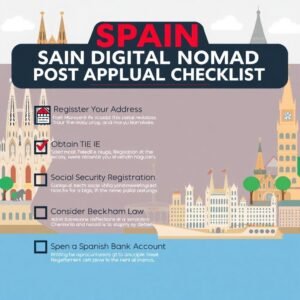
- Empadronamiento (register your address)
- Obtain the TIE (Tarjeta de Identidad de Extranjero)
- Register with Social Security (Autónomo vs. employment)
- Consider tax optimization (Beckham Law eligibility & deadlines)
- Open a Spanish bank account and get a local SIM
- Keep records and plan tax residency timing
1) Empadronamiento — register your address
What it is: Local town-hall registration that issues a residency certificate (padrón). This certificate is required for many other processes (TIE, Social Security, tax forms).
Documents typically required:
- Passport and visa approval
- Rental contract, property deed, or landlord authorization
- Completed padrón form (varies by municipality)
Timing: Do this immediately after you have stable accommodation. Some municipalities issue certificates that must be renewed or used within a limited period — submit supporting documents promptly.
Tip: Keep copies and get an official stamped certificate for later appointments.
2) Obtain your TIE (physical resident ID)
Why: The TIE is your official ID card in Spain and is required for everyday legal and financial activities.
Steps:
- Book a fingerprinting appointment at the local Foreigner’s Office or police station.
- Complete and submit the EX-17 form and pay the administrative fee (Tasa 790-012; typical fee ~€16).
- Bring passport, passport photo, Empadronamiento certificate, visa approval notice, and the stamped bank receipt.
Timing: Book as soon as your visa approval allows. Delays can complicate opening accounts or formal registration tasks.
Tip: Bring copies of all documents and confirm appointment instructions on the local police website.
3) Social Security registration (Autónomo vs. employed)
Who needs to register: All residents who will work in Spain. Structure affects contributions and benefits.
- Employed by a Spanish company: employer typically registers you.
- Self-employed (Autónomo) or freelance: you must register as Autónomo with Social Security and with the tax authorities (Agencia Tributaria).
Important: The registration date triggers social contributions and counts toward deadlines (e.g., tax regime applications).
Tip: Consider provisional contribution schemes (reduced startup rates) available to new Autónomos and confirm your monthly minimums.
4) Tax considerations — Beckham Law and residency rules
Beckham Law (special regime): May offer a favorable flat tax rate (historically around 24%) for qualifying inbound workers, but 2026 requirements are strict.
Key points:
- Filing forms (e.g., Form 030, Form 149) and online registration are time-sensitive — often within six months of registering for Social Security or arriving in Spain. Missing the window typically disqualifies you.
- Confirm eligibility: there are conditions on prior residency, type of employment/income, and duration.
General tax residency: Spending 183+ days in Spain usually makes you a tax resident; declare worldwide income if resident.
Tip: Start tax planning early — small timing errors can have major tax consequences.
5) Banking, utilities, and communications
Why: A Spanish bank account simplifies rent, payroll, Social Security payments, and tax filings.
Documents needed: Passport, TIE or proof of visa approval, Empadronamiento, and proof of income/employment.
Utilities and SIM: Set up utilities and a local SIM immediately — many government portals require SMS verification. Use SEPA direct debits for recurring payments.
Tip: Some banks offer non-resident accounts first, then switch after TIE issuance.
6) Record-keeping, health coverage, and insurance
- Keep digital and physical copies of all registration receipts, forms, and appointment confirmations.
- Health coverage: confirm whether you’re eligible for public healthcare via Social Security contributions, or maintain private health insurance until coverage begins.
- Consider income protection and liability insurance relevant to remote work.
7) Timeline & priority checklist (first 6 months)
- Days 0–14: Secure accommodation, Empadronamiento.
- Days 0–30: Book TIE appointment; open a local bank account (non-resident if needed).
- Within registration month: Register with Social Security (Autónomo or employer registration).
- Within 6 months: Apply for Beckham Law / special tax regimes (if eligible).
- Ongoing: File taxes on time, maintain records, renew TIE as required.
Common pitfalls
- Missing the Beckham Law six-month deadline.
- Not registering Empadronamiento before other appointments.
- Delays in TIE appointments leading to difficulties opening accounts or accessing services.
- Assuming visa approval equals immediate access to healthcare or tax benefits without registering with Social Security.
Documents checklist (keep ready)
- Passport + visa approval letter/certificates
- Empadronamiento certificate
- Rental contract or property deed / landlord letter
- Passport-size photos
- EX-17 form (TIE), Tasa 790-012 receipt
- Social Security registration forms / business documentation
- Tax forms for Beckham Law (where applicable)
When to contact a reliable advisor
If you want to avoid costly timing errors, ensure Beckham Law eligibility, set up the correct corporate or freelance structure, or need help with bureaucratic appointments, contact a trusted immigration and tax advisor for the post-approval stage. Professional advisors can:
- Confirm eligibility and file tax-regime applications within deadlines
- Help schedule and prepare TIE and Social Security appointments
- Set up optimal invoicing, VAT, and cross-border tax planning
Need help with post-approval formalities?
Contact CitizenXpert for a reliable advisor to manage your post-approval stage — from Empadronamiento and TIE booking to Social Security registration and Beckham Law applications. Our experts handle documentation, deadlines, and appointments so you can focus on settling into Spain. Request a consultation.
You can learn the Spain DNV application process and information through this link
Further reading and sources
- Official police/immigration and Social Security websites (check your local provincial office for appointment portals).
- Specialist tax and immigration blogs for practical step-by-step tips (keep legal advice local and up to date).

Greece’s 2026 Golden Visa changes introduce a new €250,000 startup investment path while keeping the 2024 tiered real estate thresholds. Investors working with CitizenXpert should highlight the low-cost startup and conversion/restoration options for clients seeking EU residency with no minimum stay requirement.
Key changes (2024–2026)
- Real estate thresholds (from 2024): €800,000 in high-demand zones (Athens, Thessaloniki, Mykonos, Santorini, and islands with >3,100 residents; single-property minimum 120 m²); €400,000 in other regions.
- Continued €250,000 allowance for commercial-to-residential conversions and listed building restorations nationwide.
- New 2026 option: €250,000 in Elevate Greece-registered startups (tech focus; investor holds ≤33% equity; must create/maintain 2 jobs for 5 years).
Investment options (quick reference)
- Prime-area real estate — €800,000: high-demand zones, single property ≥120 m²; long-term rental allowed.
- Other regions real estate — €400,000: less-populated areas/islands <3,100 residents, ≥120 m²; long-term rental allowed.
- Conversions/restoration — €250,000: commercial-to-residential or heritage building projects; long-term rental allowed.
- Startup investment — €250,000: Elevate Greece registry, jobs requirement, equity cap; not rental-related.
- Other routes: hotel leases (€400k–€800k) and funds/bonds (from €350,000).
Residency benefits
- 5-year renewable residence permit for investor, spouse, children ≤21 (or dependent ≤24), and parents/parents‑in‑law; no minimum stay requirement.
- Schengen travel, access to Greek healthcare and education, and eligibility for citizenship after 7 years (183 days/year requirement + language test).
- Note: work rights require a separate permit.
Processing timeline & costs
- Timeline: 2–12 months (biometrics required in Greece; applications can start remotely via power of attorney).
- Government fees: ~€2,000 main applicant, €150 per family member; €16 card issuance.
- Professional advice recommended for legal, tax, and non-domiciled HNWI planning (possible flat €100,000 foreign income tax regime).
Market stats & trends
- 27,786 permits issued by Dec 2025 (top source countries: China, Turkey).
- €5.54B real estate inflow by 2023; long-term rental yields ~3–4%.
- 2026 card changes provide full 5-year validity from issuance to reduce administrative backlog.
CitizenXpert positioning & client messaging
- Promote Greece as an affordable EU residency option vs pricier programs; stress family inclusion and rental income potential.
- Emphasize the €250k startup and conversion/restoration pathways for cost-sensitive or value-seeking clients.
- Advise clients to monitor official sources for regulatory tweaks and to obtain tailored legal/tax counsel.

Turkey remains a highly accessible “Tier B” passport in 2026: strong travel reach, a dynamic economy, and a streamlined citizenship-by-investment route starting at USD 400,000 for qualifying real estate. For investors seeking dual citizenship, family inclusion, and fast practical timelines, Turkey is a compelling option.
What the Turkish passport offers in 2026
- Broad mobility: visa-free or visa-on-arrival access to roughly 110–115 countries, plus practical pathways to Schengen long‑stay visas and the U.S. E‑2 investor visa via a Turkish company.
- Investor-friendly rules: dual citizenship permitted, no language test, no mandatory physical residency before or after naturalization. Adult passports are typically issued with 10‑year validity and full civic rights (property, education, healthcare).
Core program options (2026)
- Real estate: Minimum investment of USD 400,000 in qualifying property(ies), with a three‑year holding requirement and a Tapu annotation restricting sale.
- Capital deposit / securities: Minimum USD 500,000 in bank deposits, government bonds, or qualifying funds, locked for three years.
- Business investment: Job-creating enterprises that formally employ a required minimum number of Turkish citizens (official verification applies).
Family members (spouse, children under 18, and certain dependents) can be included in the primary application.
Typical timeline and practical “fast track”
Official processing commonly spans 6–12 months from investment to passport for well-prepared cases. A realistic workflow for prepared clients:
- Weeks 2–6: Asset selection, valuation, due diligence, purchase or deposit confirmation.
- Month 1–2: Residence permit application and issuance via digital channels.
- Month 2–4: Citizenship file submission and background checks.
- Month 4–8 (sometimes to 12): Approval, national ID issuance, then passport application and delivery.
Government processing usually consumes 3–8 months; strong structuring and flawless documentation are where time is saved.
What’s new in 2026
- Stronger due diligence and mandatory criminal-record checks from applicants’ countries of residence.
- Required biometric capture and physical presence at specific stages.
- More centralized, digital portals for document upload and tracking, reducing manual delays when files are complete.
How Citizenxpert delivers a credible sub‑6‑month route
Citizenxpert doesn’t change the law — we compress the practical journey by eliminating idle time and preventing common setbacks:
- End-to-end roadmap: We sequence investment, residence, and filing steps so nothing sits idle.
- Local legal and compliance partners: On-the-ground teams manage Tapu annotations, bank compliance, valuations, and portal submissions to avoid rejections and retries.
- Pre‑validated family files: Civil documents are legalized, translated and pre‑checked to prevent last‑minute gaps.
With disciplined execution and rapid client cooperation, Citizenxpert positions serious investors to obtain Turkish citizenship and a passport in under six months from engagement — aligning with the fastest documented outcomes for fully prepared applications.
Interested in a tailored assessment? Contact Citizenxpert for a confidential eligibility review and a customized fast‑track roadmap.

Portugal: The Rise of the Investment Fund
Real estate in Portugal may be off the table for immigration, but the Golden Visa is very much alive. Capital is now flowing into Private Equity Funds, offering a more sophisticated route to citizenship.
Hands-Off Efficiency
The €500,000 Fund option is perfect for the investor who wants no maintenance headaches. It offers professional management, diversification, and a clear path to an EU passport after 5 years, often with better liquidity than property.

Visa Consulting & Coaching Training provide with a great place to Service, whether you are there to burn off some calories or are.

Visa Consulting & Coaching Training provide with a great place to Service, whether you are there to burn off some calories or are.

Visa Consulting & Coaching Training provide with a great place to Service, whether you are there to burn off some calories or are.

Visa Consulting & Coaching Training provide with a great place to Service, whether you are there to burn off some calories or are.

Visa Consulting & Coaching Training provide with a great place to Service, whether you are there to burn off some calories or are.